
Flexibility, lending and amenities: The future of coworking from different angles

The fact that coworking is here to stay came as an answer in unison from leaders of Blackstone, Citibank, Barclays, Hines, Cushman and Wakefield, Morrison & Foerster and Fisher Brothers. As seen from different angles, this disruptive phenomenonposes opportunities as well as challenges to prove the long-term sustainability ofits business model.
”When we think about the future of office, it is about flexibility and service - it is almostlike the 'hotelization' of asset classes. The level of amenities expected is higher” said David Steinbach from Hines. The increased focus on amenities in real estate is not new and it seems to be the norm in most asset classes today. However, in the office space, this statement remains as relevant as ever. ”We are on the opening act of a multiple act play about what is happening”, he affirms.
Kenneth Fisher from Fisher Brothers built upon this opinion, saying that ”coworking haschanged the way corporations are now designing space, as well as the way landlords now look at space”.
When asked about the sustainability of coworking, speakers seemed to agree that the decision is being led by companies’ balance sheet accounting. ”The ability of coworking to provide flexibility for the workforce is one aspect, but the ability to keep real estateoff balance sheet is another part of that”, said David Bouton from Cushman Wakefield.
The second panel of this session featured executives from Blackstone, Barclays and Citi Bank, who explored the concept of coworking from a lenders’ perspective.
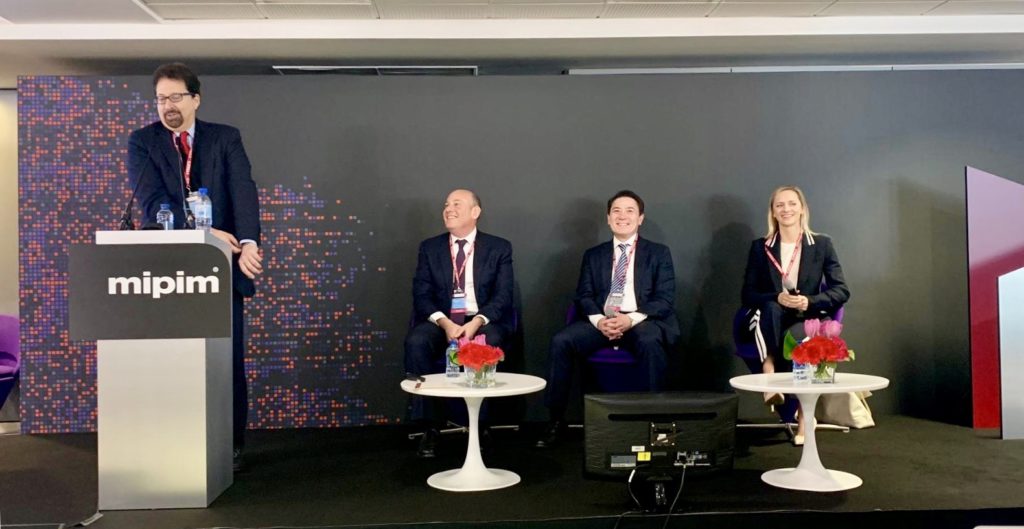 Mark Edelstein (Morrison & Foerster LLP), Michael Lascher (Blackstone), David Bouton (Citigroup Global Markets), Kristin Khanna (Barclays Bank PLC)
”[Coworking companies] have longer-term leases that are mismatched with the shorter- term tenancy that rents their space”, said David Bouton from Citigroup, ”it still remains to be seen but I think they diversified away from just two people that need a little bit of space into tenants with more staying-power and the capital who can survive a downturn and who are more likely to remain in the space.”
Speakers agree that coworking is becoming more innovative in terms of mitigating risks that could lead to more opportunities for lenders, while still remaining a strong concept that appeals to tenants, employers and office owners alike.